

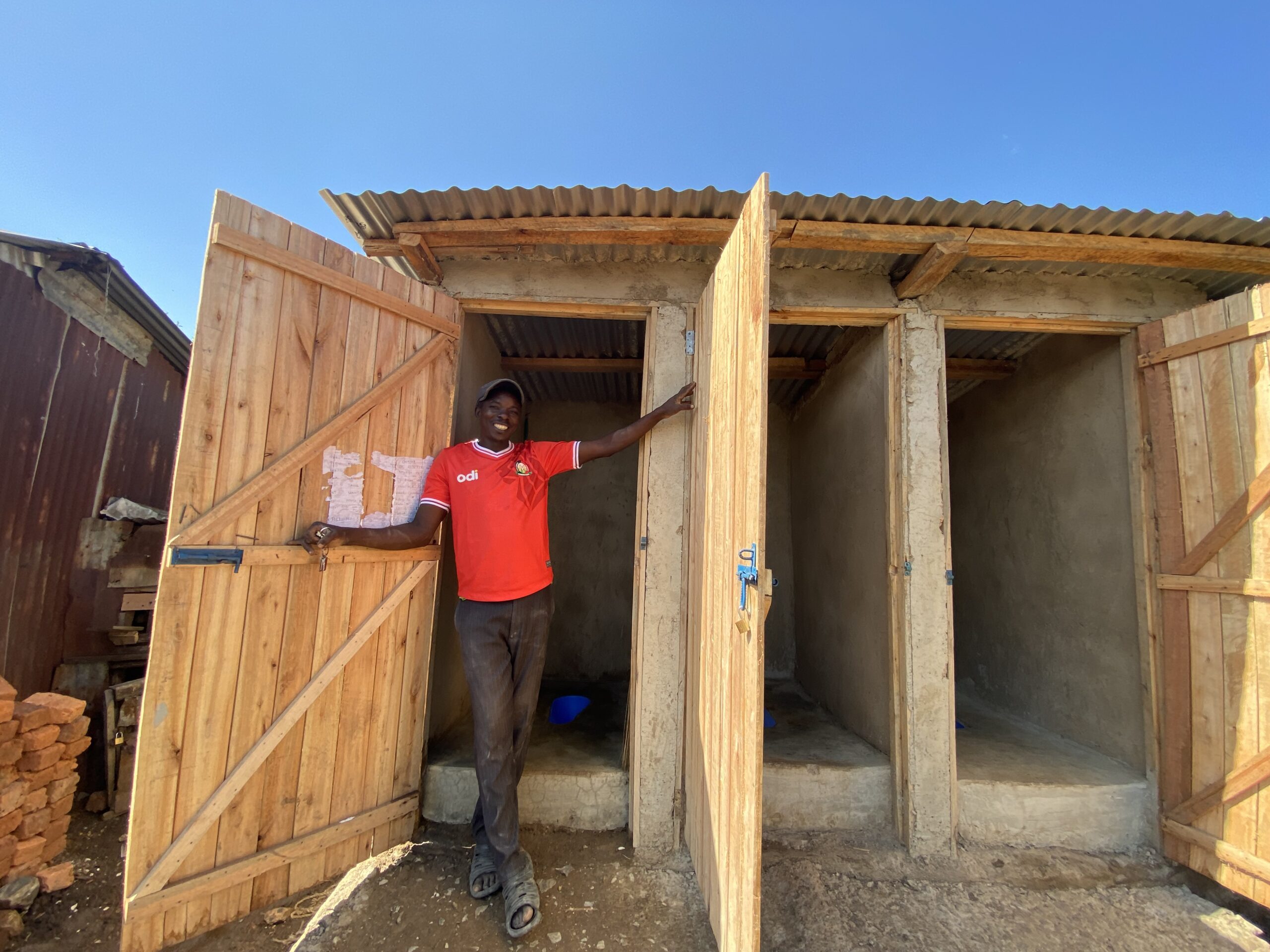
Mason and Landlord, Eric next to his newly constructed toilets
In many low-income urban communities, the biggest barrier to improved sanitation is not the lack of demand but the lack of access to finance.
For Eric, a mason and landlord living in Manyatta Kaego, a low-income settlement in Kisumu, Kenya, this reality shaped the sanitation conditions in his compound for years.
The pit latrine he had built earlier filled up quickly, often every two to three months. Each time it filled, emptying it came with high costs that were difficult to sustain. Over time, the toilet became a constant source of stress for both Eric and the tenants living in his compound.
The toilet itself was also far from ideal. The squat hole was large and unsafe for children, making many of them afraid to use it. During the rainy season, the situation became worse, with maggots appearing and unpleasant odours spreading across the compound. Because of the wide opening, sometimes tenants also disposed of non-degradable waste in the pit, causing it to fill even faster.
The sanitation conditions eventually became so frustrating that some tenants began threatening to move out.
Learning to Build Better Sanitation
Eric works as a mason, and his turning point came when he participated in training provided by FINISH Mondial (FM) . Through the training, he learned how to construct improved sanitation facilities that are safer, more hygienic, and more durable for shared residential compounds.
Inspired by the designs he had learned, Eric decided to construct a better toilet facility for his tenants.
However, like many landlords in low-income settlements, Eric quickly encountered a major challenge. While he had the technical skills to build the facility, he did not have enough money to complete the construction.
Halfway through the project, the work stalled.
When Access to Finance Makes the Difference
All was not lost though. Through FM, Eric received guidance on how he could access sanitation financing to complete the project. He was connected to Elphrods Services, a financial institution offering sanitation loans designed specifically to help households and landlords invest in improved sanitation facilities.
With the loan, Eric was able to complete the construction of a three-door, safely managed toilet for his compound.
“The training gave me the knowledge, but the loan made it possible to finish the toilet,” Eric explains.
The improved facility now serves fifteen households and is safe and accessible for everyone, including children. The foul smells and flies that once affected the compound are gone, and the toilet has not required emptying since it was completed in 2024.
For tenants, the difference has been immediate and meaningful.
“Before, some tenants wanted to leave because the toilet filled too quickly,” Eric says. “Now they are happy to stay.”
Unlocking Sanitation Markets Through Financial Inclusion
Eric’s experience highlights an important lesson: improving sanitation in low-income communities often requires more than technical solutions. Access to affordable financing is critical.
Through its market-based approach, FM works to strengthen sanitation systems by connecting entrepreneurs, households, financial institutions, and Governments. By linking trained artisans like Eric with financial institutions such as Elphrods Services, the programme helps unlock investments that allow improved sanitation facilities to be built and sustained.
For Eric, the sanitation loan did more than complete a construction project. It improved living conditions for 15 households and created a facility that will serve the community for years to come.